

 I picked this up at the library, after reading Nymeth's and Deweys' review, and I have to say it was a great choice.
I liked the art, the storyline apparently simple but carrying more than one meaning, the connections with the author Beatrix Potter (creator of Peter Rabbit), and the choice of talking about sexual abuse with frankness.
It's the story of Helen, a teenager who has run away from home after being abused by her father for years. She starts begging in the streets and tubes of London. Then meets a group of squatters and joins them, but leaves them soon after for the country, following Beatrix Potter's trail, her inspirer and model.
There's many things that make this story of survival a special one. I love, first of all, the parallel between Helen and Beatrix Potter's lives. They both had to leave home to free themselves from an oppressive family. And both have visions, which identifies them as true artists. This connection is wonderfully transformed into a Potter-ish tale at the end, called The Tale of One Bad Rat, who stood up against the big evil cat, and made a name for herself.
Eventually Helen stands up against her monster, showing that is possible to confront your worst fears, by just saying things out loud.
Rats have an important symbolic meaning. As Helen puts it, they are scavengers, thus survivors, just like her. Her little pet rat represents the way she feels about herself, disgusting and dirty, but also capable of escaping, surviving, and finding out that she is not the dirty one, after all.
The drawings are very powerful throughout the whole book, but they become even more significant, to me, at the end, when Helen is in the countryside. I believe it was nature that gave her strength, that had a revealing power for her. I could feel it in every frame. Because even if I didn't go through what Helen goes through, I always feel regenerated and energized when I'm surrounded by beautiful natural landcapes: a wood, a river, the top of a hill. It's electrifying. I think this was a big part of Helen's healing process.
So, yes, there's more than one layer to appreciate, and that what intrigued me the most.
I also liked that the art style was not just beautiful, but also very accessible. It could appeal and be understood by anybody, even those unaccustomed to the grammar of graphic novels.
And this is important for a story that could help change people's lives.
also reviewed at:
Nymeth
Dewey
Meexia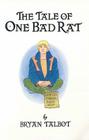
Shop Indie Bookstores
Saturday, 31 January 2009
The Tale of One Bad Rat - Bryan Talbot


Friday, 30 January 2009
Surprise!
Today something small and wonderful happened. I arrived in work in the bookshop, and I found out I wasn't supposed to be in. But instead of going back home, I managed to get tomorrow off instead (as I thought I had). Anyway, the assistant manager gave me the lovely job of dusting the whole shop (!) , "since you're not supposed to be in". I tried to protest, adding to my cause that dust makes my nose itchy for the whole day, but to no avail. So I set off unhappily to dust every shelf, even the top ones. But what do I see while dusting one of those top shelves? A note in a book! An envelope to be precise. I was in the gardening section and the book was The bedside Book of the Garden. For a moment I thought that someone forgot their book there with a note inside. But then I opened it and the enveloped said "For you", with a little rainbow drawing at the bottom of it. Well then, it's for me! I opened it and look what I found inside.
This was the front on the folded letter: And this was the message inside:
 A message saying simply "Your potential is infinite".
Included in the envelope there were also some mysterious seeds.
Obviously I checked that email address and it led me to this blog about a week of events around this art project called Change Dublin, going on now.
But I didn't find any mention of letters being left around the city. So maybe it was actually a lost envelope? Or just a way of publicising the event? I don't know.
To me, though, it felt like a message I need to believe in.
Tomorrow I'll buy a pot and plant the seeds, I can wait to see what they are.
Wednesday, 28 January 2009
The Handmaid's Tale - Margaret Atwood
 Sometimes, when I read dystopian fiction I try to distance myself from it, thinking it's only fiction, that it might happen, but Thank God it hasn't. In the case of this book, truth is, it has. Maybe not in my country, or in yours, but somewhere in the world, in the past ,or even now, those things have happened or are happening. This is what makes it not just scary or disturbing, but profoundly sad.
Everything that the regime does in The Handmaid's Tale has being done before, and if this doesn't give you the shivers, I don't know what can.
The Handmaid is a woman who's telling the tale, but she never says her real name. She's only known through the patronymic Offred (of Fred), referring to the Commander who she belongs to. She's living in a future America, called Gilead, where a religious fundamentalist organization has taken power, and has stripped women of their freedom, so painfully earned in centuries of struggles.
Now fertile women who have been living a non orthodox life (in non married relationships, or divorced for example) have a "choice" to either become Handmaids or to go to the colonies and be condemned to a slow death through toxic exposures to radioactive waste.
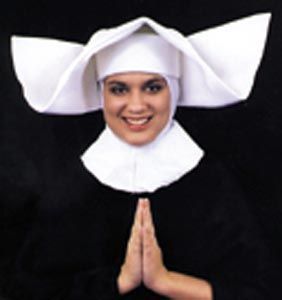
Every handmaid has to wear a long concealing red habit and a white headgear similar to this (sorry, didn't find a better picture).This doesn't allow for much conversation. In fact is specifically designed to discourage conversations and to deprive women of a free view of the surrounding world, as well as to keep their faces hidden.
The Wives have a little more freedom, but they too are required to wear a blue habit, and to accept the presence of handmaids in the house.
In this future, fertility is The Problem. Pollution and nuclear radioactivity have crippled the humans' ability to procreate, so now women are regarded as an instrument, a container, whose only purpose is to bear children.
There is so much to be outraged about this regime, I don't even know where to begin. The saddest thing, though, is that something the Aunts (women who train and control the handmaids) said in the book reminded me of what I have read about women living in fundamentalist Islamic societies. In an interview, a woman claimed to be happy to wear the hijab, because it gave her freedom. It allowed her not to be looked at, not to be showcased, not to be whistled at in the streets, to be regarded for her personality and not for her beauty.
This mentality is exactly what the Aunts meant when they were saying that women now had another kind of freedom. Instead of being free TO, they were free FROM.
It also shows that for women brought up within this mentality, their condition will become normal, even liberating. They won't miss what they never had.
I'm not aware of the women's liberation movement in theocratic societies (not to self: research!), but I can draw a parallel with what Marjane Satrapi says in Persepolis. Women hated the hijab at first and would take it off as soon as they could.
I've only talked about Islamic fundamentalism because that's the only direct contemporary example that I can think of. But it must be said that Atwood was thinking more about the early Puritans who came to America, and in fairness the existence of such people is equally scary. But I don't want to dip too much into that or I'll start shaking with rage.
Let me talk more about the book instead. Far from being an essay on women's condition in totalitarian regimes, this is firstly the story of a woman, which I found totally compelling. It was the kind of book that I couldn't stop reading. At bus stops, on bus, walking to work. Everywhere. I found the writing absolutely beautiful, and thought-provoking. I especially appreciated the way the narrator expressed the sense of emptiness that her new life gave her now. I've always thought that if I ever had to go to prison, as long as I could have books and that I could write, it shouldn't be too bad. But Offred is not allowed to read, nor write. Worse than prison, this is Hell!
Her days are made of empty hours waiting for the little events of the day: lunch, shopping, dinner. And the Ceremony once a month. The reproductive activity with the Commander and her wife, which is hard to call sex.
Mostly, her days are spent waiting, thinking about little things like the ray of light that comes through the window, the possible meanings of the word "chair", the geography of an eggshell.
If reading is forbidden, then a single sentence in Latin, engraved in the cupboard, by the previous handmaid, becomes en enormous transgression. A mantra to hang on to.
But probably the fact that she has been torn away from her life, her husband, her baby daughter, is what alienates her the most. Her body doesn't belong to her anymore. She's not entitled to feel pleasure, to be held just for the sake of it.Can I be blamed for wanting a real body, to put my arms around? Without it, I too am disembodied. I can listen to my own heartbeat against the bedsprings, I can stroke myself, under the dry white sheets, in the dark, but I too am dry and white, hard, granular; it's like running my hand over a plateful of dry rice; it's like snow. There's something dead about it, something deserted. I am like a room where things once happened and now nothing does, except the pollen of the weeds that grow up outside the window blowing in as dust across the floor.
There'd be so much more to say about it, but I've blabbed long enough.
The very last thing, only, is about the ending. I was like "WHAT?". Open ending, no conclusion. I still loved it, but I wouldn't have minded to know what happens to her.
There was an interview to the author at the end. When asked if this is science fiction, she firmly denies it:
Science fiction is filled with martians and space travel to other planets and things like that...The Handmaid's tale is speculative fiction in the genre of Brave New World and Nineteen Eighty-four.
But I choose to regard speculative fiction as a branch of science fiction, so it still counts for my Sci-Fi Experience!
other blog reviews:
Life and Times of a New New Yorker
In Spring it is the Dawn
Reading Reflections
Under the Dresser
Bold.Blue.Adventure
Care's Online Bookclub
Just What You Want
Book-a-Rama
Things mean a lot
Melody's reading corner
Rebecca Reads
The Bluestocking Society
A guy's moleskine notebook
Did I miss yours?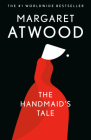
Shop Indie Bookstores
Tuesday, 27 January 2009
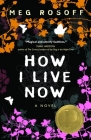
How I live Now - Meg Rosoff

It would much easier to tell this story if it were all about a chaste and perfect love between Two Children Against the World at an Extreme Time in History but let's face it that would be a load of crap.
The real truth is that the war didn't have much to do with it except that it provided a perfect limbo in which two people who were too young and too related could start kissing without anything or anyone making us stop.
I knew Meg Rosoff from Just in Case. I didn't like the book itself, but I fell in love with the writing. How I live Now is less sophisticated in the language, but definitely a much more engaging story.
It's about 15-year-old Daisy, a Newyorker who is sent to England to spend the summer with her cousins in the country. It seems the beginning of a perfect summer. Daisy finds a welcoming and caring family, an idyllic landscape, and love. But World War III has other plans for them, and it won't be long till it catches up with Daisy's perfect life.
Although I was completely enthralled by the story, I was even more enamoured with the style. Rosoff created a language for Daisy that was overflowing. It ran fast and effortlessly and enthralled me completely. The use of indirect speech and capitalized letters was funny and pertinent, while the wording of sardonic phrases such as my unpleasantly populated subconscious made me giggle with delight.
Beside the style, the characters are the kind that you're going to miss at the end, and wish you had met. Especially sweet, serious, little Piper, with her dog Jet, and Isaac, who understands animals more than people, and Edmond, who can read people minds.
Daisy is a great character too and I loved the way she grows up through the course of the summer. She tells the story in first person, but at first you can tell she's not completely honest, especially about her anorexia. As if she was trying to underestimate her problem, even to herself. But as things unravel and war gets in the middle between her and her newfound love, Daisy will have to deal with the immediacy of reality and somehow overcome her personal problems in order to take care of others.
In the midst of all the drama, though, there is space for glimpses of humour, thanks to Daisy's ironic view of the world. One of my favourite scenes is when, to help Jet who is great at guiding the cows to pasture but can't do everything, they find a silly Border Collie named Ben:
Piper tried to train some sense into dim Ben, practising over and over again until he was just this side of useless. He still ran away bleating if any of the cows took it into their heads to look at him sideways, but most of the time they couldn't be bothered and he managed to muddle through. Sometimes I caught Jet giving him a look that was totally unimpressed and I could almost see Jet thinking Excuse me, who invited this blockhead to the party? And sometimes I wondered if he might be thinking the same thing about me.
It didn't end the way the way I wanted, but it didn't have to. I guess there couldn't have been a different ending, but in my heart I always imagine a bit more, a little bit far ahead in the future, and I see it shining bright. What can I say, I'm a hopeless romantic.
other blog reviews:
Things mean a lot
The Hidden Side of a Leaf
The Written World
Leafing Through Life
Out of the Blue
Bending Bookshelves
A Striped Armchair
Bold Blue Adventure
In Spring it is the Dawn
Some Reads
The Written Word
Presenting Lenore
The Compulsive Reader
Adventures in Multiplicity
Miss Print
“Fiddle-de-dee’s not English”
Shop Indie Bookstores
Monday, 26 January 2009
Mailbox Monday

To be honest, from the list I'm going to show you, only one came literally in the mailbox. And because I bought it. The rest is just plain old weakness. One was a "present", though:P
So there we go:
The Anatomy of Wings by Karen Foxlee.  This will be published in March and I'm reading it now. I noticed it plainly because Mark Zusak, author of The Book Thief strongly recommends it and because it says it will appeal to those who liked How I live now by Meg Rosoff, The lovely bones by Alice Sebold (haven't read it but I will), and The Virgins Suicides by Jeffrey Eugenides (haven't read it but I liked the film).
It's about ten-year-old Jennifer, who is growing up in the Australian Outback,while trying to come to terms to her thirteen-year-old sister's death.
I'm enjoying it, but I will talk more about it when I'm finished. I'm glad 'cause it suits the 2009 Pub challenge :D
The House at the Pooh Corner by A.A. Milne.  I haven't read any Pooh's books yet! And I know this is not the first, but it was on sale, for something like 2 euro, and I couldn't resist. Should I read the first book first?
The Demon's Lexicon by Sarah Rees Brennan.  From the back: Sixteen-year-old Nick knows that demons are real. Magicians call up demons in exchange for their power. The demons can appear in any shape, show you marvels, promise you anything - until you invite them in and receive their demon mark of death...
Demons, magicians and a sexual allure.
Perfect for Twilight fans (I'm not).
Deals with siblings relationships.
I don't know about this. It sounds a lot like The Amulet of Samarkand, but I hope it won't be, because I still have to read that one and I don't want to spoil it. Also not a Twilight fan.
But I will read it because our buyer needs feedbacks. It's published in June.
The fact that she is a fellow blogger is a point in her favour though
The Hunger Games by Suzanne Collins.  After reading so many good reviews I decided to take it home. After all it's a proof copy, hence free:) I'm expecting to like it a lot, so I don't want to be disappointed!
Freedom next time by John Pilger.  Anytime I go near the Current Affair section I think I want to read this book, so I've bought it, finally. It deals with stolen rights in Afghanistan, India, Palestine, South Africa and also Britain and United States and about the courageous people who are battling to free themselves. I'm really looking forward to this, even though it won't be an easy read.
Honey and Clover by Chica Umino. My first manga of the year. I didn't realise how much I missed reading manga (mangas) till I read this. I loved it and will review it soon. This is the only book that actually came in my mailbox.
The Tale of One Bad Rat by Bryan Talbot. I went to the library to look for manga and instead I saw this. I had read Nymeth's review earlier this year so I was really curious about it. I wasn't disappointed, this was brilliant stuff and will be reviewed soon too!
Sunday, 25 January 2009
Another List, a.k.a. EW’s New Classics Books Perpetual Challenge

Another list! I've been meaning to post this for ages, but I didn't find the chance. Now here's my chance: a challenge about it, hosted at The Review from Here.
Oh how I love these lists, even if they're incomplete, even if they make me feel like I wasted my time and never read the books that count, even if I will never complete them.
Anyway, this challenge is a perpetual one. Just cross the books off as you read them. I know I'm really bad with these perpetual thingies. Just look at my Booker Project...Basically I just read whatever, and if it happens to suit the project, fine. Otherwise, I won't make any more efforts towards it. I expect to do the same with this.
(In Italics those on the tbr shelf).
1. The Road , Cormac McCarthy (2006)
2. Harry Potter and the Goblet of Fire, J.K. Rowling (2000)
3. Beloved, Toni Morrison (1987)
4. The Liars’ Club, Mary Karr (1995)
5. American Pastoral, Philip Roth (1997)
6. Mystic River, Dennis Lehane (2001)
7. Maus, Art Spiegelman (1986/1991)
8. Selected Stories, Alice Munro (1996)
9. Cold Mountain, Charles Frazier (1997)
10. The Wind-Up Bird Chronicle, Haruki Murakami (1997)
11. Into Thin Air, Jon Krakauer (1997)
12. Blindness, José Saramago (199 8)
13. Watchmen, Alan Moore and Dave Gibbons (1986-87)
14. Black Water, Joyce Carol Oates (1992)
15. A Heartbreaking Work of Staggering Genius, Dave Eggers (2000)
16. The Handmaid’s Tale, Margaret Atwood (1986)
17. Love in the Time of Cholera, Gabriel García Márquez (198 8)
18. Rabbit at Rest, John Updike (1990)
19. On Beauty, Zadie Smith (2005)
20. Bridget Jones’s Diary, Helen Fielding (1998)
21. On Writing, Stephen King (2000)
22. The Brief Wondrous Life of Oscar Wao, Junot Díaz (2007)
23. The Ghost Road, Pat Barker (1996)
24. Lonesome Dove, Larry McMurtry (1985)
25. The Joy Luck Club, Amy Tan (1989)
26. Neuromancer, William Gibson (1984)
27. Possession, A.S. Byatt (1990)
28. Naked, David Sedaris (1997)
29. Bel Canto, Anne Patchett (2001)
30. Case Histories, Kate Atkinson (2004)
31. The Things They Carried, Tim O’Brien (1990)
32. Parting the Waters, Taylor Branch (198 8)
33. The Year of Magical Thinking, Joan Didion (2005)
34. The Lovely Bones, Alice Sebold (2002)
35. The Line of Beauty, Alan Hollinghurst (2004)
36. Angela’s Ashes, Frank McCourt (1996)
37. Persepolis, Marjane Satrapi (2003)
38. Birds of America, Lorrie Moore (199 8)
39. Interpreter of Maladies, Jhumpa Lahiri (2000)
40. His Dark Materials, Philip Pullman (1995-2000)
41. The House on Mango Street, Sandra Cisneros (1984)
42. LaBrava, Elmore Leonard (1983)
43. Borrowed Time, Paul Monette (198 8)
44. Praying for Sheetrock, Melissa Fay Green (1991)
45. Eva Luna, Isabel Allende (1998)
46. Sandman, Neil Gaiman (1988-1996)
47. World’s Fair, E.L. Doctorow (1985)
48. The Poisonwood Bible, Barbara Kingsolver (1998)
49. Clockers, Richard Price (1992)
50. The Corrections, Jonathan Franzen (2001)
51. The Journalist and the Murderer, Janet Malcom (1990)
52. Waiting to Exhale, Terry McMillan (1992)
53. The Amazing Adventures of Kavalier & Clay, Michael Chabon (2000)
54. Jimmy Corrigan, Chris Ware (2000)
55. The Glass Castle, Jeannette Walls (2006)
56. The Night Manager, John le Carré (1993)
57. The Bonfire of the Vanities, Tom Wolfe (1987)
58. Drop City, TC Boyle (2003)
59. Krik? Krak! Edwidge Danticat (1995)
60. Nickel & Dimed, Barbara Ehrenreich (2001)
61. Money, Martin Amis (1985)
62. Last Train To Memphis, Peter Guralnick (1994)
63. Pastoralia, George Saunders (2000)
64. Underworld, Don DeLillo (1997)
65. The Giver, Lois Lowry (1993)
66. A Supposedly Fun Thing I’ll Never Do Again, David Foster Wallace (1997)
67. The Kite Runner, Khaled Hosseini (2003)
68. Fun Home, Alison Bechdel (2006)
69. Secret History, Donna Tartt (1992)
70. Cloud Atlas, David Mitchell (2004)
71. The Spirit Catches You and You Fall Down, Ann Fadiman (1997)
72. The Curious Incident of the Dog in the Night-Time, Mark Haddon (2003)
73. A Prayer for Owen Meany, John Irving (1989)
74. Friday Night Lights, H.G. Bissinger (1990)
75. Cathedral, Raymond Carver (1983)
76. A Sight for Sore Eyes, Ruth Rendell (199 8)
77. The Remains of the Day, Kazuo Ishiguro (1989)
78. Eat, Pray, Love, Elizabeth Gilbert (2006)
79. The Tipping Point, Malcolm Gladwell (2000)
80. Bright Lights, Big City, Jay McInerney (1984)
81. Backlash, Susan Faludi (1991)
82. Atonement, Ian McEwan (2002)
83. The Stone Diaries, Carol Shields (1994)
84. Holes, Louis Sachar (1998)
85. Gilead, Marilynne Robinson (2004)
86. And the Band Played On, Randy Shilts (1987)
87. The Ruins, Scott Smith (2006)
88. High Fidelity, Nick Hornby (1995)
89. Close Range, Annie Proulx (1999)
90. Comfort Me With Apples, Ruth Reichl (2001)
91. Random Family, Adrian Nicole LeBlanc (2003)
92. Presumed Innocent, Scott Turow (1987)
93. A Thousand Acres, Jane Smiley (1991)
94. Fast Food Nation, Eric Schlosser (2001)
95. Kaaterskill Falls, Allegra Goodman (199 8)
96. The Da Vinci Code, Dan Brown (2003)
97. Jesus’ Son, Denis Johnson (1992)
98. The Predators’ Ball, Connie Bruck (198 8)
99. Practical Magic, Alice Hoffman (1995)
100. America (the Book), Jon Stewart/Daily Show (2004)
[In red the books I've read after joining the EW challenge]
CBC’s 2009 Teen Choice Book Award

I got an e-mail asking me to mention this on my blog and I do it with pleasure!
Teenreads.com is collaborating with the Children's Book Council offering teens an opportunity to share their five favorite books of 2008. The five titles that receive the most “votes” will serve as the finalists for the CBC’s 2009 Teen Choice Book Award.
A list of nominees can be found at http://www.teenreads.com/
My List:
The Graveyard Book- Neil Gaiman
Nation - Terry Pratchett
The Adoration of Jenna Fox - Mary E. Pearson
The Tygrine Cat - Inbali Iserles
Me, the Missing and the dead - Jenny Valentine